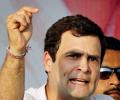
Congress vice president Rahul Gandhi on Sunday launched a scathing attack on opposition BJP over its "double-standard" attitude towards corruption and attempt to "divide the society on communal lines".
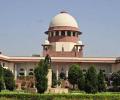
The nullifying of the NJAC Act has put the spotlight on the Judiciary. Concepts like transparency, being open to change, leading from front, management of perceptions that were reserved for the Executive earlier are now relevant for the Judiciary as well, says Sanjeev Nayyar.
'Now, we have a minimum pension of Rs 1,000 annually.'

A chemical engineer, Anirudh gave up his high-paying job to work for welfare of farmers in Tamil Nadu.

'There has to be an 18-month transition.' 'But if the government had some prior knowledge that the high value notes were being used for an imminent terrorist activity in the country, then we have to accept the step.'

'Go to any village, you'll find a Dalit 15 years and above wearing jeans.' 'Earlier, Dalits were not allowed to wear a dhoti till the ankles. Jeans does not have this kind of restrictions or design. It is universal. So Dalits have also entered a caste neutral clothing zone.' 'Wherever you see Dr Ambedkar's statue in this country or abroad, he is always wearing a suit and with that English comes naturally. The Dalits' veneration of Western dress is very intense,' Dalit thinker Chandrabhan Prasad tells Archana Masih/Rediff.com

Indian farming was transformed after the mid-60s.

Recent statistics show that the situation is no different across the country with several hospitals lacking the infrastructure to manage a breakout of a blaze.

No account of the 1962 war could be complete without Maxwell's authoritative analysis. Which is why we are reprinting this article which was run on Rediff.com in June 2001.

Congress vice president Rahul Gandhi was back in action on Saturday after he met farmers over land bill in Delhi, a day before the party's big kisan rally.

The linking of biometric UID/Aadhaar number to all public services makes "We, the People of India" worse than slaves, says Gopal Krishna.
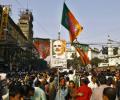
It has been said that by 2025, India could become among the top five economies in the world. If India does become a $5 trillion economy but gets all its rivers polluted, food chain poisoned and genetic pool depleted and biometric database of Indians sold or stolen at the behest of commercial czars, will it not be a pyrrhic economic victory, asks Gopal Krishna.

'Prime Minister Manmohan Singh refused to allow us to project his real personality to let the people of India know exactly what he really was. He was always shying away from greater public exposure. Since the last two years we have seen enormous criticism, ridiculing the prime minister. He has been made into an object of jokes. It certainly hurts. I think this man deserves lots of good reviews... His contribution to social policy, his contribution to the economy, his contribution to coalition management, his contribution to foreign policy.' Dr Sanjaya Baru, Dr Singh's former media advisor who is in the eye of a storm over his book on the prime minister UPA speaks to Rediff.com's Sheela Bhatt.


Glimpses of the final days of the 1965 War, as seen from the diary then defence minister Y B Chavan maintained during the war.

'Narendra Modi knows how to calculate and remain pragmatic. Take the unexpected Rafale deal - perhaps the first time a PM has considered the country's defence procurement as a priority, over the considerations of the babus... and over his own pet project 'Make in India',' says Claude Arpi.
The eye of the debate has been focused too tightly on the quantum of punishment rather than the current approach, both to the juvenile, and also, for making him/her accountable, says Puja Marwaha

Rajeev Srinivasan on how India has continued to disappoint, but could outdo Singapore one day.

The new ordinance on land acquisition will allow land grabbers to deprive millions, destroy agriculture, horticulture, rivers, forests, tree cover and mangroves to extract minerals as well as ground water, without replenishment at a pace that will not leave anything for the next generation, warns activist Medha Patkar.

Finance Minister P Chidambaram, while addressing the Carnegie Endowment for International Peace on "Recapturing India's Growth Momentum" in Washington on Thursday, said that the leading think tank need not launch an initiative to explore how India will vote in 2014, declaring that the Indian polity will vote the Congress back into power.

Endless cases, piles of files, meagre resources and unrelenting scrutiny... the CBI's life story is all that and more, says Ruchika Chitravanshi

'Can we forgive the pathologist who wrongly labelled a healthy person as a diabetic patient for receiving the favour of the referring physician and possibly for a few thousand rupees?' 'The delinquent homeopath who caused a cataract in a child by giving terribly wrong drug must go to jail.' 'How can we permit a gynaecologist to practice her/his specialty if s/he tinkers with the faith of the patient in an abhorrent way?' 'Paying money does not guarantee good healthcare. The private healthcare system largely treats patients as revenue generators,' crusading doctor Dr Arun Gadre tells Dr K S Parthasarathy.

'It is not about women today; it's about men.' 'We need to focus our energy on a war footing on men.' 'Let us start with a boy who is 10 years old.' 'If you don't concentrate on your son, the safe spaces for women will shrink further.'

Contrary to the bragging that marked its two-year anniversary, the government's timidity on reform is simply astounding.

'It is a very hard won situation that the army has brought about in J&K in 25 years, we don't want to fritter it away...' 'By 2010-2012 the terrorist strength had come down to 300, 400. From a high of 3,000 to 4,000 to 300 to 400 was no mean achievement for the army,' says Lieutenant General Syed Ata Hasnain (retd).

Here's the full text of Prime Minister Narendra Modi's address to the United States Congress.

A recent inquiry report by the Geneva-headquartered Office of the High Commissioner for Human Rights has cast serious aspersions on the claims of the Sri Lankan government over alleged war crimes duirng the conflict with the LTTE. Vicky Nanjappa reports.
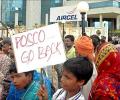
Is it inconsistency in policy, or the lack of robust support?
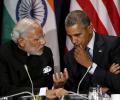
'Big countries do not agree on every set of issues.' 'Look, one of the differences in the relationship is that when we do not agree, we are sitting down and talking to each other.'

The government has provided a long-term vision.

Phee Teik Yeoh says that the worst is behind them.

Biometric authentication is based on the unscientific and questionable assumption that there are parts of human body that does not age, wither and decay with the passage of time.

'This is not a Sanjay Baru or Natwar Singh type of book. It's not a memoir. It's not a book to reveal conversations, real or imaginary. This is not a book to position myself at the centre of the world.' Jairam Ramesh on his stint as environment minister.

Claude Arpi gives a fascinating firsthand account of the Dalai Lama's arrival in Tawang in March 1959 and explains why he will once again receive a grand welcome, whether Beijing likes it or not.

US Ambassador Richard Verma's tips to the Indian states.
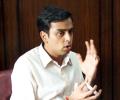
Milind Deora, minister of state for communication and information technology and shipping, is one of the Congress' young guns under Rahul Gandhi. He tells Kavita Chowdhury that the core problem for the United Progressive Alliance in its second term has been its inability to communicate effectively. Edited excerpts:

Expecting an annual CSR spending of Rs 15,000-20,000 crore (Rs 150-200 billion) by India Inc, Corporate Affairs Minister Sachin Pilot has asked companies to see the new law as an investment opportunity to create a better work environment, rather than a forced expenditure.

'The origins of the model of planned economic development adopted by independent India was a direct consequence of the war.' 'The war provided an opportunity for groups at the margins of Indian society to find new avenues for mobility.' 'The war also led to the emergence of India as a major Asian power and set the stage for it to play a wider role in international politics.'

The announcement of the formation of the BRICS bank will have as much an impact about how the non-G7 countries manage their economies and their foreign reserves, as it does on the intellectual discourse. The development priorities and agenda which was hitherto set by western experts responding mostly to western priorities and notions will now have to compete with an intellectual tradition that is and can be very different, says Mohan Guruswamy.

'If you say I won't talk to them at all, does terrorism stop?' 'Even if they say they will give up terrorism, "I will fight terrorism along with you," but even then you say I still won't talk to you until you do the following things, then that is a political call.'
 © 2026 Rediff.com - Advertise with us - Disclaimer - Privacy Policy - Sitemap - Feedback - About us - Terms of use - Grievances